The video is real, but nobody believes it anymore
Imagine that tomorrow a video appears showing corruption in your city hall. The video is real. But one sentence is enough to destroy its value: “That’s just AI.” And many people believe this sentence more than their own eyes.
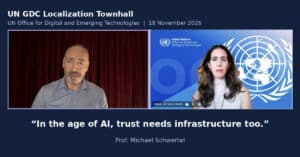
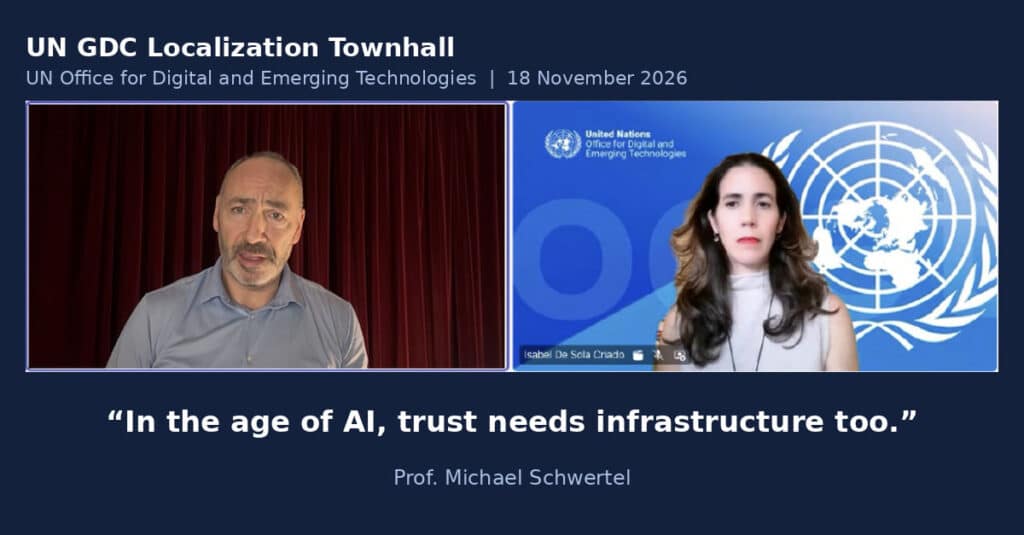
I described exactly this scenario at the United Nations on 18 November 2026. At the GDC Localization Townhall of the United Nations Office for Digital and Emerging Technologies, I spoke to more than 200 participants from city governments and UN organisations around the world. The event was about how cities can put the Global Digital Compact into practice. UN member states adopted this agreement in 2024.
My main point was this. The biggest danger of AI may not be that we believe fakes. It is much more dangerous when we stop believing real images.
Liars profit from perfect fakes
In 2019, the legal scholars Robert Chesney and Danielle Citron gave this problem a name, the “liar’s dividend”. The more people know that images, videos and voices can be faked perfectly, the easier it becomes to call real evidence fake. A liar no longer needs to create a fake. It is enough to create doubt.
This hits the local level hardest. Many towns have only a small newsroom left, or none at all. Trust there depends on individual people, for example the mayor or the local reporter. If their images and statements can simply be dismissed as AI, a community quickly loses the common ground it needs for debates in the city council or before a local election.
Why labelling alone is not enough
The obvious answer is to label AI content and to improve media literacy. Both are important. But both have limits.
Today, even experts often cannot reliably tell real images from generated ones. And a study from the University of Bristol shows that even a clear warning does not cancel the effect of a deepfake. Simon Clark and Stephan Lewandowsky ran three experiments with people who watched a fake video after being told it was fake. The warning reduced the influence of the video, but did not remove it. Many participants knew the video was fake and still believed the person in it was guilty (study in Communications Psychology).
If labelling fakes only works to a limited extent, we need to turn the question around. We need to make it possible to prove what is real.
Trust needs infrastructure
Cities naturally take care of infrastructure for water and roads. In the age of AI, trust needs infrastructure too. There are two steps cities can take right away.
Digital seals for real content. Anyone can add a digital seal to their photos and videos, public authorities and newsrooms as well as individuals. The open standard C2PA, also known as Content Credentials, records in a verifiable way who took a picture and how it was edited, and it makes later changes visible. When a city marks its official photos and videos like this, citizens can check what really comes from the city. Anyone who claims such a video is AI must then argue against verifiable proof.
A plan for emergencies. Every local digital strategy should define what happens when a deepfake hits the community. Who checks the facts, who informs the public, and how fast? Especially before elections, the first hour often decides which version of events people believe.
The Global Digital Compact already commits states to information integrity. Now the task is to put this into practice at the local level, because that is where people decide whether they still believe each other.
What matters now
Wherever in the world a community can no longer agree on what happened, it can also no longer decide what to do next. That is why deepfakes are not only a technical issue. They touch the foundation of democratic decisions.
I have been working on artificial intelligence since 2015, and I work with newsrooms, associations and public institutions on AI fakes and disinformation. If you would like to talk about how to protect trust in real information in your city or organisation, I look forward to your message.
Prof. Michael Schwertel spricht und berät zu Künstlicher Intelligenz in Medien, Kommunikation und Organisationen. Themen wie dieses bringt er als Keynote oder Workshop in Redaktionen, Medienhäuser und Unternehmen. Kontakt und Vortragsthemen