
AI in journalism is usually tied to one big question. Will artificial intelligence replace journalists?
At Besser Online 2026, , the digital conference of Deutschen Journalisten-Verbands at Radio Bremen, I discussed exactly this question.
My argument was that AI will not replace journalists. The real challenge is what happens when people believe they no longer need journalism at all, because an AI answers every question for them directly.
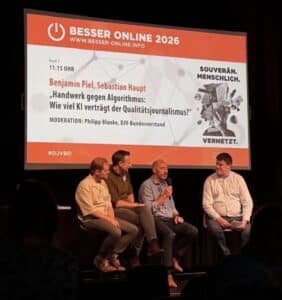
On September 5, I was a guest at Besser Online 2026 at Radio Bremen. This year the conference of the German Journalists Association ran under the motto „Souverän. Menschlich. Vernetzt.” and asked how journalism can stay independent and human in a digital world.
That question led me to artificial intelligence twice on the same day. First on the panel “Craft versus Algorithm. How Much AI Can Quality Journalism Take?”, where I discussed the use of AI in newsrooms together with Benjamin Piel, editor in chief of the Weser-Kurier, and Sebastian Haupt, head of Spotlight at CORRECTIV. The panel was moderated by Philipp Planke from the national board of the DJV. Later, in my own talk “Are We Making Ourselves Obsolete? When Fakes Stop Mattering. Trust as the Last Currency of the Public Sphere”, I looked at a more fundamental question, which is what happens to journalism and to the public sphere when synthetic content becomes the normal case.

Can AI Write Like a Journalist by Now?
The debate about AI and journalism almost always starts with text. Can an AI write a good journalistic article? The answer today is much less comfortable than it was two or three years ago. Language models produce text that sounds professional. They structure information, come up with headlines, imitate different tones, cut a piece to a given length and summarize large amounts of material.

AI can write text, and it will keep getting better at it. The more interesting question is whether we can still reliably tell which text came from a human and which one came from a machine. And the question after that is whether this even matters to readers, as long as they find the text good.

On the panel, Sebastian Haupt described an experiment at CORRECTIV in which texts written by AI and texts written by journalists were put side by side and presented to an audience. Which texts did people prefer, and could they tell which ones were generated? Experiments like this matter, because they test a comfortable assumption that is common in the industry. At the same time they do not go far enough if we want to use them to decide whether AI can replace journalists. Writing is only one step in journalism, and probably not even the hardest one.
AI in Journalism Is Not About Producing Text
AI will not replace journalists, and not because it could never write good text. The difference lies somewhere else.
An AI processes what already exists. It works with data, documents, images, statements and publications, finds patterns in them, makes connections and combines sources into a new text. But someone has to observe that reality first.
Someone has to sit in a city council meeting and notice that a statement does not match the numbers in the budget draft. Someone has to talk to people nobody has asked so far. Someone has to request documents, research the background, live with contradictions and decide that a topic is relevant in the first place. And someone has to be there when something new happens.
For me this is a central point in the debate about generative AI. The spirit of the times is not stored in old training data. Training data mostly documents what has already happened, what has been written, photographed, published and digitized. Journalism deals with what is happening right now. The information and the trends that future AI systems will work with have to be produced by people first.
Who Actually Produces the Knowledge That AI Summarizes?
This creates a paradox that occupies me a lot. The more capable AI systems become, the more easily they can condense journalistic content and make it accessible. At the same time they depend on journalists having researched that content at all.
Take a local example. An AI can explain in a few seconds why a hospital in a certain city is going to be closed. But where does that information come from? Probably from an article in the local newspaper, from a piece of reporting by the regional public broadcaster, from council documents, from conversations with staff or from an investigation that took months. The AI mixes all of it together into an average result.
The AI can bring all of this together, but it was not at the staff meeting. It did not talk to the nurse. It did not follow up with the responsible ministry. And it did not decide to spend three weeks on a lead, even though at the start it was not clear whether there would be a story at all. That is a contribution of journalism that is regularly underestimated in the current AI debate, because it is invisible in the finished text. On top of that, over those three weeks a human reporter builds a complete picture of the situation.
The Bigger Risk Is About Access
Still, it would be wrong to conclude that journalism is protected from the effects of AI. I only believe that we are looking for the danger in the wrong place.
The biggest challenge for media companies may not be that an AI replaces their journalists. It may be that AI replaces the access to journalism. That shifts the perspective on the problem quite a bit.
So far, digital journalism works roughly like this. I have a question or I am interested in a topic, I search for it, I come across a journalistic piece and I read it. With generative AI this path changes. I ask directly what the new pension reform means for me, why the government is split on a certain point, what happened in Europe today or what the new AI regulation actually requires. And I get an answer written just for me, without opening a newspaper, without turning on a news broadcast and in many cases without clicking a single link.
In the long run I consider this the biggest structural challenge for journalism, and it hits the business model at a point that better writing cannot defend.

AI Becomes the User Interface of Our Reality
If this development continues, AI systems will position themselves as a new layer between journalism and the audience. The newsroom does the research, journalists talk to sources, correspondents report from the scene, investigative teams work on a story for months, and the media company pays for all of it. In the end the user asks an AI and receives the essence of that work there.
This also shifts power. Whoever formulates the answer also decides which sources become visible, which aspects are highlighted and which perspectives disappear. That is not only an economic question for media companies. It is a question for society.
A Plausible Answer Is Not Yet Journalism
We should keep one basic difference in mind. A plausible answer is not automatically a journalistic answer.
Generative AI is excellent at condensing information, and that is exactly where the problem lies. Journalism is not about connecting existing statements as elegantly as possible. Journalism asks whether something is true at all, who is claiming it, what interests are behind it, who disagrees, which information is missing, why this is being discussed right now and what we might not be seeing yet.
A language model can help with such questions. It analyzes documents, searches through data, transcribes interviews and structures large amounts of information, and many newsrooms already use it for that. But journalistic responsibility cannot be delegated to a language model, because a model is not liable for anything.
The Point of View Becomes More Important, Not Less
In our discussion at Besser Online we were surprisingly close to each other on one point, even though we started from different positions. The point of view of journalists remains decisive.
At first this sounds almost old fashioned. In the age of generative AI, though, this personal and professional way of seeing could gain in value. If in theory anyone can produce an average good text on a topic within seconds, then the average good text loses its value. What becomes valuable is what cannot be reproduced at will, meaning your own research, your own observation, your own sources, experience, context and a visible editorial position on how information is checked.
When Fakes Stop Mattering
This discussion led directly to my second topic of the day. In my talk I asked what happens when synthetic media become an everyday thing.
With deepfakes we usually discuss how perfect a fake has to be before people fall for it. By now that is probably the wrong question as well. We are moving toward a media world in which the mere possibility of a fake is enough to create doubt. A real photo can be called AI generated, a real video can be dismissed as a deepfake, an authentic audio recording can be questioned without any evidence.
This changes the burden of proof. It is no longer only the fake that has to look credible. Increasingly, the real thing has to prove that it is real. For journalism this is a heavy load, because the effort shifts from reporting to providing proof.

Trust Could Become the Most Important Currency in Journalism
That is why I believe trust becomes more important in the age of AI. If the volume of synthetic content keeps growing, at some point the decisive question will no longer be whether I can tell that a piece of content was made with AI. It will be whom I trust to have checked it.
That would be a remarkable shift. A technology that seems to make journalistic content endlessly reproducible could be the very thing that raises the value of credible journalistic brands again. Provided that these brands manage to keep their trust.
Putting a logo on top of a text is not enough for that. Media have to make it understandable how they work, where their information comes from and where they use AI. They have to correct mistakes visibly and explain at which points humans made the decisions. Trust is created through actions that people can follow and verify.
AI Is Not the Enemy of Journalism
I do not think much of reducing this discussion to humans against machines. AI can be an extremely capable tool for journalists, for research, for structuring large sets of documents, for data analysis, for transcription and translation or for making different sources comparable.
Newsrooms are using AI. The question is which tasks we hand over to AI and which responsibility has to stay with people. For me the line runs where information processing turns into journalistic responsibility.
Maybe We Should Look at AI in Journalism Differently
“Will AI replace journalists?” is an understandable question. After Besser Online 2026 I find a different one more useful. What does journalism have to deliver so that people still need it in a world full of AI answers?
We do not have to produce text faster than a machine. That is a competition we lose. Journalism has to offer what cannot be synthesized from existing information, meaning original research, new findings, closeness to people and events, verifiable sources, responsibility and trust.
That is where the real opportunity lies. The easier it becomes to generate answers, the more valuable it becomes to have someone who asks the right questions and is willing to take responsibility for the answers.
Prof. Michael Schwertel speaks and advises on artificial intelligence in media, communikation and organizations. He brings topics like this one into newsrooms, media companies and businesses as a keynote or workshop. Contact and speaking topics