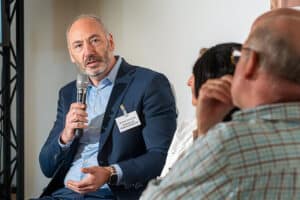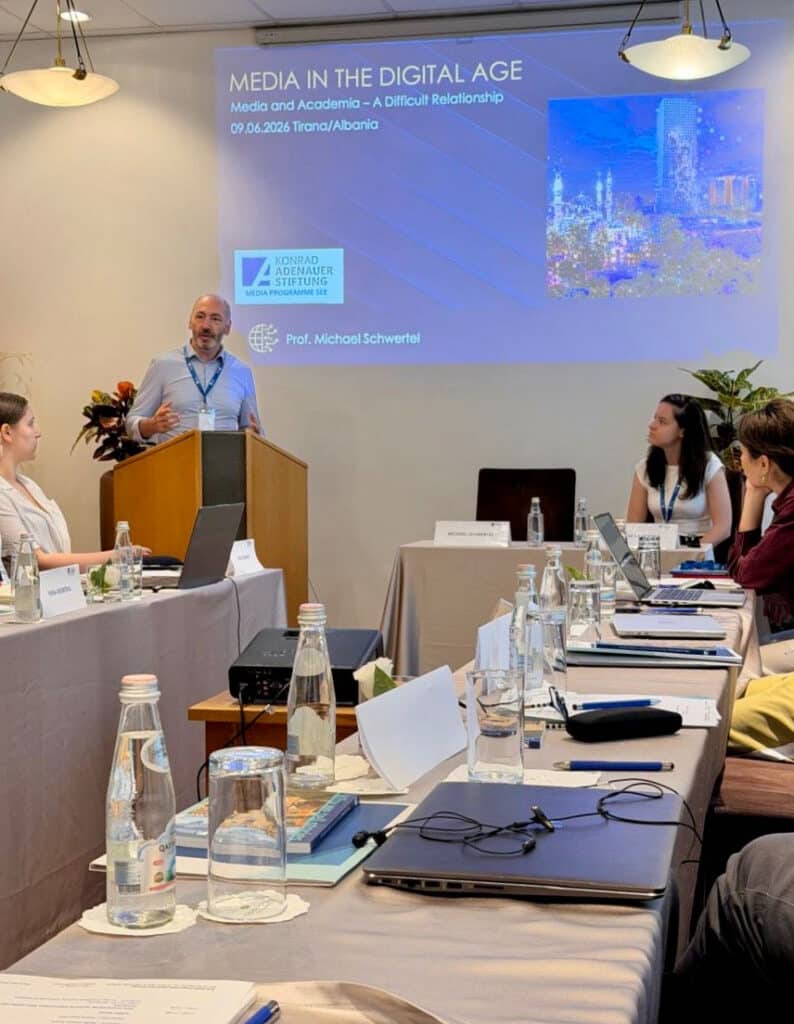
There are conference moments you cannot plan. This was one of them. I am standing in a hotel conference room in Tirana, talking about slopaganda and how real images are increasingly mistaken for fakes. Less than ten meters away sits the office of Prime Minister Edi Rama. And right there, just outside our door, the demonstrations that are currently moving all of Albania are gathering. Young and old, families, students, retirees. An entire country seems to be on its feet.
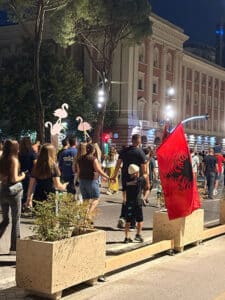
Slopaganda theory inside, reality outside. The two rarely come this close.
Media and Academia: One Conference, Ten Countries, the Same Questions
I had been invited by the Media Programme South East Europe der Konrad-Adenauer-Stiftung, led by Christoph Plate. The title of the conference: “Media and Academia: A Difficult Relationship.” A program that deliberately brings scholarship and journalistic practice into friction with one another.
The list of participants read like an atlas of the media world: the Dean of the Graduate School of Media and Communications at Aga Khan University in Nairobi, a professor from the University of Sarajevo, the Dean of the Caucasus School of Media in Tbilisi, a lecturer and deputy editor from Karachi, the Director General of the public broadcaster of Bosnia and Herzegovina, and journalists and media researchers from Albania, Kosovo, North Macedonia, Romania, Bulgaria, Georgia, and Ethiopia. And me, as a voice from Germany.
What surprised me most after the first conversations: the challenges are remarkably similar. Whether in Nairobi, Sarajevo, Tbilisi, Karachi, or Cologne, newsrooms and universities everywhere are wrestling with the same questions. How do you train journalists for an industry that changes faster than a curriculum can be written? How does reporting stay credible when every image can be faked? And who actually explains to society what is happening right now?
My Talk: Media in the Digital Age
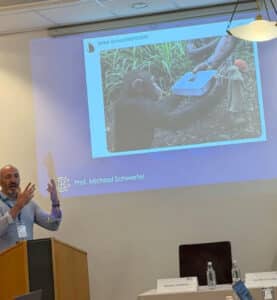
My slot was on Tuesday afternoon, moderated by Ralitsa Stoycheva from the KAS team in Sofia. About twenty minutes of input, followed by a long and intense round of questions with an audience that works with media reality every day.
So I began with a question to the room: how does artificial intelligence feel to you? Everyone answers that question only for themselves. And then I showed how it feels to most of us. Like a fast roller coaster where you cannot get off at the next turn.
Because the speed is real. In 2023, AI shaped its first usable 3D objects out of simple illustrations. A 3D artist who used to build four objects a day was suddenly expected to deliver 120. Two weeks later, a plugin appeared that could generate an entire New York City in a single day. Today we step into images as if we were in Harry Potter and move through AI-generated 3D worlds. These are not future scenarios. These are the production conditions behind slopaganda, and they now sit in the hands of every schoolchild.
If Gutenberg Had Invented the Internet in Five Days
The heart of my talk, however, was not technical but cultural. Humanity had centuries to get used to new media technologies. From the clay tablets of the Sumerians, through the scriptoria of the Middle Ages, to the printing press, generations passed in which societies could learn how to deal with new forms of information.
Today we do not have that time. Or, as I put it in Tirana: if Gutenberg had invented the internet in five days, we would not yet be able to read, but we would already have to worry about cookies.
That is exactly our situation. Technology does not wait until we are ready. It never has. But the gap between what is technically possible and what people and institutions can process has never been this wide. While research labs work on world models, the receptionist at the dentist’s office writes down your next appointment with a pencil, simply because there is no time to learn the new software. Both are the same present.
Slopaganda: The Underestimated Manipulation
And this brings us to the real problem. The public debate still revolves around the question of whether we can recognize AI fakes. Deepfakes, manipulated photos of politicians, faked voices. That matters, but it is only the surface.
The greater power comes from something we can call slopaganda. Mass-produced AI content that works like propaganda, even when it is openly recognizable as AI-generated or is actually labeled as such. What makes it so insidious is that slopaganda also works through its critics.
I showed an example from German reporting in Tirana. A journalistic format quotes AI-generated images of demonstrations in order to classify them and explain them as extreme examples. It sounds like clarification. But in fact, this very framing carries the narratives further. The image stays in your mind. The explanation does not. An AI problem with no technology involved, created right in the middle of quality journalism.
The consequence is a double erosion, because AI content works despite being labeled, and real footage falls under general suspicion. When authentic images of real events are reflexively dismissed as fakes, journalism loses its most important asset. Not because AI lies, but because truth becomes unbelievable.
What South East Europe Is Ahead of Us On
In the discussion that followed, something happened that I had not expected so clearly. The colleagues from South East Europe, the Caucasus, and East Africa read the manipulation patterns I showed faster than I am used to from audiences in Germany. Those who know propaganda from their own social experience recognize its mechanics more quickly.
In Germany, we tend to treat such phenomena as a technical problem that can be solved with labeling requirements and detectors. The conversations in Tirana strengthened a different suspicion in me. Media resilience may be less a question of technology than a question of experience. Societies that have lived through manipulation possess a kind of radar that we are only beginning to develop.
This is not a comfortable conclusion, but perhaps the most important one I took home from Albania.
What Remains in Times of Slopaganda
In the evening after my talk, we sat together over dinner while a few streets away the demonstration was still going on. There was discussion, disagreement, laughter. This is exactly what conferences like this are for. Not only for talks that fade away, but for connections that last.
My thanks go to Christoph Plate and his team at the KAS Media Programme South East Europe for the invitation and for putting together such a remarkable group.
What remains is the question I am taking with me from Tirana: is media resilience a question of technology, or a question of experience?

My thanks go to Christoph Plate and his team at the KAS Media Programme South East Europe for the invitation and for putting together such a remarkable group.
What remains is the question I am taking with me from Tirana: is media resilience a question of technology, or a question of experience?
Read more about talks on understanding AI in the media here.