Observations from the ARD/ZDF/Deutschlandradio/DW Freelancers’ Congress in Bonn and what they reveal about the future of public service journalism.
AI in public service broadcasting is probably the most controversial topic I currently encounter in newsrooms. Just how controversial became clear at the ARD/ZDF/Deutschlandradio/DW Freelancers’ Congress in Bonn.
“Keep AI out of public service journalism.” That was the demand of the Freelancers’ Council. Der Freienrat.
This call came from the audience at the congress. Clear, direct, and met with applause. It did not surprise me.
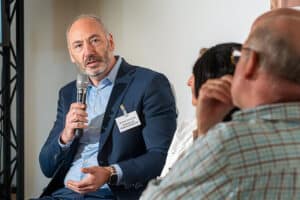
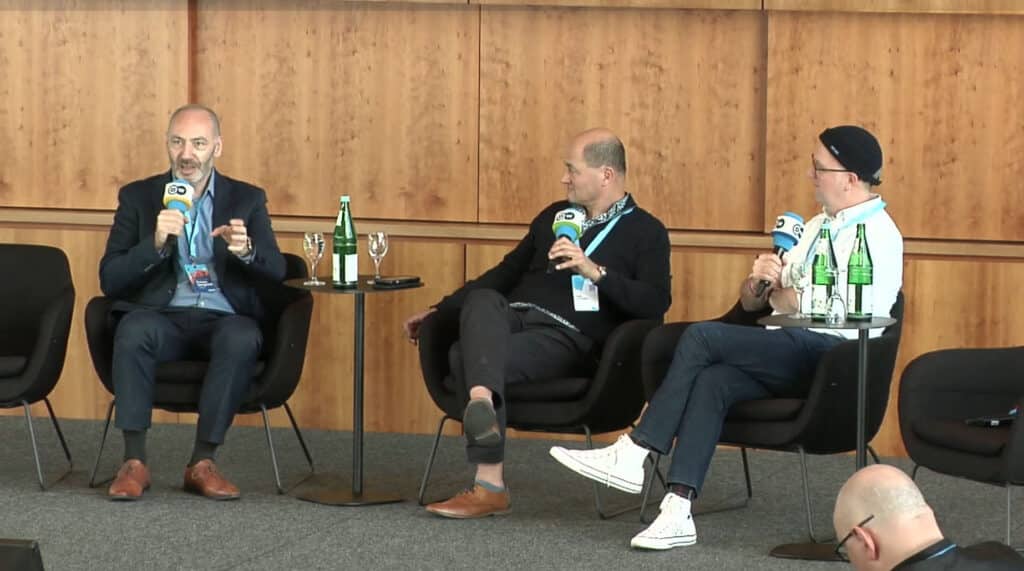
On the panel with Jan Eggers, moderated by Stefan Tiyavorabun, we discussed the question that comes up in almost every workshop I run with newsrooms: Is AI a job killer or a power tool? The answers in the room could hardly have been more different. And exactly this tension says more about the future of public service broadcasting than any strategy conference of the past few years.
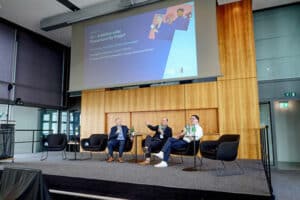
Two Camps, One Shared Uncertainty About AI in Public Service Broadcasting
On one side stood a clear demand: keep AI out of public service journalism. Use it as a quality seal. Protect real journalistic work as a safe space. This position has serious logic behind it. If everyone else … commercial platforms, influencers, automated news aggregators … relies on AI-generated mass content, then handcrafted journalism could become a real point of difference. “Made by humans” as a brand promise.
On the other side was the practical view: AI as a tool. For better research. For more efficient processes. For removing repetitive tasks that eat up hours every day … hours that should go into actual journalistic work. Transcripts, first-step research, translations, real-time fact-checking, multimedia preparation. This position is not naively pro-tech. It sees AI for what it can really do: it removes routine work, so more time stays for what machines cannot do.
And in between these two camps and this was the real theme of the day… you could feel one thing above all: uncertainty.
Why the Mood Shifts
I see this uncertainty very directly. In my workshops with newsrooms, with freelancers, with students at journalism schools. It is especially clear with trainees and young journalists. These are the people who are just starting their careers, and for them this question is existential.
The pattern is almost always the same. The first 30 minutes of a workshop run in an atmosphere of careful curiosity. We show tools, try out prompts, look at first results. The mood is open, almost playful.
Then comes the moment when the full impact becomes clear. When participants understand how fast and how deeply AI is changing not only single tasks but entire job profiles. When they realize that this is not just a new tool in the toolbox, but a fundamental shift in who will still be working as a journalist in five years and in what role.
In this moment, the mood shifts. From curiosity to frustration. Sometimes to anger. Often to a kind of quiet resignation. Because suddenly the question is in the room that nobody wanted to ask: What role do I actually still have here?
The Decisive Shift
And exactly at this point, something happens that I see as the most important finding. If this understanding stops at fear, it creates paralysis. Defensive thinking. The demand to exclude AI is often exactly that: an attempt to preserve a state that no longer exists.
But if the understanding moves into action, something completely different happens. Suddenly, new freedoms appear. Ideas that used to fail because of budget or staff become possible. Personal projects that sat in the drawer for years become realistic. Research that used to take two weeks can now be prepared in two days — and the time that becomes free flows into what really creates journalistic value: into conversations, into on-site research, into deeper context.
This is the moment when a threat becomes a tool. Not through technical training alone. It happens through a shift in mindset.
What Public Service Broadcasting Must Decide Now
Public broadcasters now face a decision that goes far beyond questions about tools. The real question is not which AI tools to use. The real question is how the institution deals with the fact that the profession itself is changing radically. I see three dimensions as central.
First: Rethinking quality. The position “no AI as a quality seal” is not wrong. It is just incomplete. If public broadcasters define their quality only by not using AI, they define themselves only in opposition to others. That is a weak position. A stronger question is: What kind of quality emerges when AI is used in the right places (where it replaces routine) and the time that becomes free flows into research, sources, and context? That would be a quality seal based on added value, not on avoidance.
Second: Clarifying roles. Trainees and young journalists today need more than training in classic journalistic techniques. They need a clear idea of what role they will have in a newsroom where AI handles standard tasks. Ignoring this question, or postponing it with “we’ll figure it out later,” is the most uncertain strategy of all. Especially because innovations are coming faster and faster.
Third: Taking the cultural dimension seriously. Public service broadcasting is an institution with a public mission. This mission does not change just because the tools change. But the way the mission is fulfilled does change. The cultural question is this: Do we keep control over topic selection, editorial judgment, and social relevance, or do we hand it over to algorithms that follow a different logic? Public broadcasters do not have to follow that logic. But they must understand that they are exposed to it.
Three Observations from Over Ten Years of AI Practice
I have worked systematically with artificial intelligence in media since 2015. In this time, I have observed three patterns that are highly relevant for the current public broadcasting debate.
The first pattern: Organizations that integrated AI early and strategically have not become less journalistic – they have become more journalistic. Because routine work was reduced, more energy was left for ambitious formats. The fear that AI would make journalism shallow has not come true in these organizations. As long as the strategic direction was clear.
The second pattern: Organizations that treated AI only as an efficiency topic (meaning, as a way to cut staff) saved money in the short term and lost substance in the medium term. AI as a pure cost-cutting tool does not work. AI as a complement to human skill does work.
The third pattern, and this is the most important one: The biggest variable is not the technology. It is the mindset of the people working with it. The same technology can strengthen or weaken a newsroom – depending on whether it is seen as a threat or as a tool. This mindset cannot be created through strategy papers. It develops through real practice, with guidance, in spaces where experimenting is allowed.
What This Means for the Discussion in Bonn About AI in Public Service Broadcasting
Back to the Freelancers’ Congress. The demand “keep AI out of public broadcasting” is understandable, but it does not solve the real problem. The real problem is not AI. The real problem is the question of how public service journalism can stay relevant in a media environment that is changing fundamentally right now.
AI does not replace journalism. But it changes radically who does journalism, and how. Those who see this change as a threat will experience it as a threat. Those who see it as a tool will open up spaces that did not exist before.
If you’re not at the table, you’re on the menu. This sharp formulation describes quite well the choice that public service broadcasting and with it every newsroom, every freelance journalist, every trainee is facing right now.
The real question, then, is not whether we use AI. It is whether we learn to use it in a way that makes us more relevant.
Here is the video from the congress: Video
Here is the program of the event.
Prof. Michael Schwertel is a keynote speaker, workshop leader, and consultant focusing on AI, digital transformation, and the future of media. He has worked systematically with artificial intelligence in the media context since 2015. For talks and workshops on AI in public service broadcasting: get in touch.