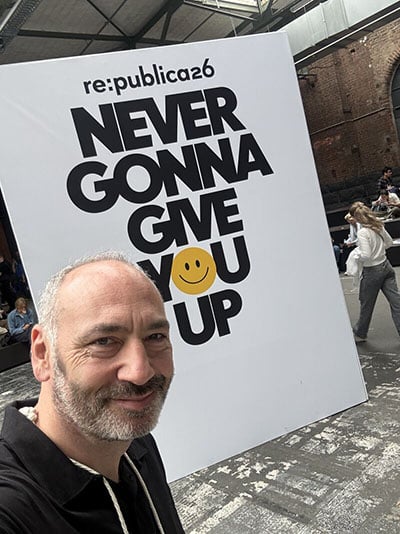
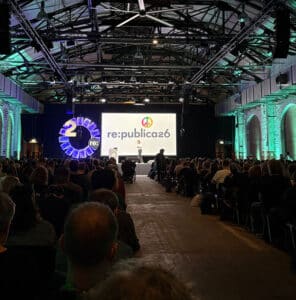
re-publica 2026 was once again what it always is: Europe’s most important gathering for everyone who wants to shape the digital society – not just observe it.
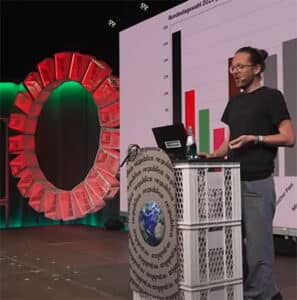
This year, I had the opportunity to give my own talk. And I am still excited by that experience.
The Talk: When Fakes Stop Mattering
“When Fakes Stop Mattering: Trust as the Last Currency of the Public Sphere”, that was my topic. And it touches a problem that sits right at the heart of what media makers, journalists, and anyone with reach are facing right now.
The central argument: the problem of AI-generated images and videos is not their existence. It is who shows them and why.
A concrete example: In November 2025, one of Germany’s most-watched talk shows broadcast an AI-generated video showing Trump responding to protesters. Everyone watching knew it was fake. Yet Trump’s narrative stuck – not the seven million people who had taken to the streets.
That is the mechanism I analysed in the talk. Who shows something determines its meaning and impact. Labelling requirements don’t solve this. Studies confirm that people trust the content of deepfake videos even when explicitly warned beforehand that the video is fake.
What remains is trust in the sender. Media brands, journalists, influencers with reach – they all decide every day what becomes part of the public discourse. Showing something is never a neutral act. Not even with context provided.
Fakes don’t need to deceive to have an effect. They just need to be shown.
Slopaganda – When Propaganda Becomes Fun
AI-generated content has given rise to a new form of propaganda I call Slopaganda: content that is entertaining, emotional, fast and digestible and goes viral precisely because of that. Unlike classical propaganda, which lectures or intimidates, Slopaganda spreads because it is enjoyable. The Lego films from Iran showing Trump and Epstein together. The AI video of Trump in a fighter jet. The Merz Muppet on TikTok. All obviously fake. All shared millions of times. The subtext travels with every share – whether you intend it or not. Whoever laughs, spreads it. Whoever spreads it, legitimises it.
What the Research Says
This is not just observation. It is scientifically documented. A study in Communications Psychology (2026) shows across three experiments that people rely on the content of deepfake videos when making moral judgements, even after being explicitly warned that the video is fake. The warning changes nothing. Even more concerning: Ahmed et al. (2024) examined the relationship between deepfake awareness and susceptibility to disinformation across eight countries. The result: people who know what deepfakes are and understand how they work are more likely to doubt whether real images are genuine. Media literacy alone no longer protects. The effect persists regardless of education or cognitive ability.
What Needs to Happen Now
The question is no longer whether AI-generated content will continue to be produced. That cannot be stopped. The question is how we – as newsrooms, journalists, and everyone with reach – respond to it. Three principles help:
Make the unseen visible. Anyone reporting on an AI video should also show what it displaces – the seven million protesters, the real footage, the actual context. Editorial responsibility begins not with what you show, but with what you leave out.
Treat attention as a scarce resource. Not every viral fake deserves coverage. The decision to show something is always a decision not to show something else. That trade-off must be made consciously.
Don’t use AI content as entertainment. The narratives carried by this content are too complex and too powerful for that. Whoever shows an AI video for effect gives it meaning – no matter how good the contextualisation that follows.
Trust cannot be repaired through labelling. It is built through consistent editorial judgement in every decision, every day.
My Three Highlights of re:publica 2026
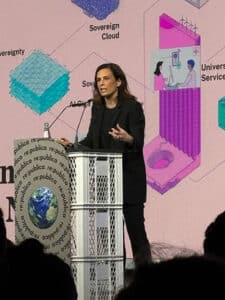
Francesca Bria delivered one of the most striking talks of the festival. She laid out the steps toward a digital dystopia with the precision of a necklace of pearls – not as doom and gloom, but as an exact analysis of what happens if Europe fails to act. Dark, but necessary. The talk made the unavoidable obligation to act unmistakably clear – especially for Germany.
Arne Semsrott delivered one of the strongest moments of the festival in one of the final talks. Anyone who takes transparency and freedom of information for granted was given a sharp correction.
Most important of all: the people. re:publica is not just a conference format. It is a place where people come together who are actively working toward a positive future. Ideas don’t emerge on stage – they emerge in the conversations in between. For that I am deeply grateful to the entire re:publica team and everyone who was there.
If you are looking for a speaker for your next event or a KI-Workshop for your organisation, I look forward to hearing from you.