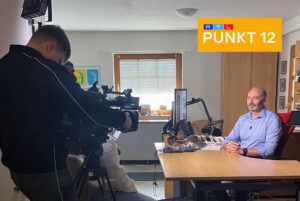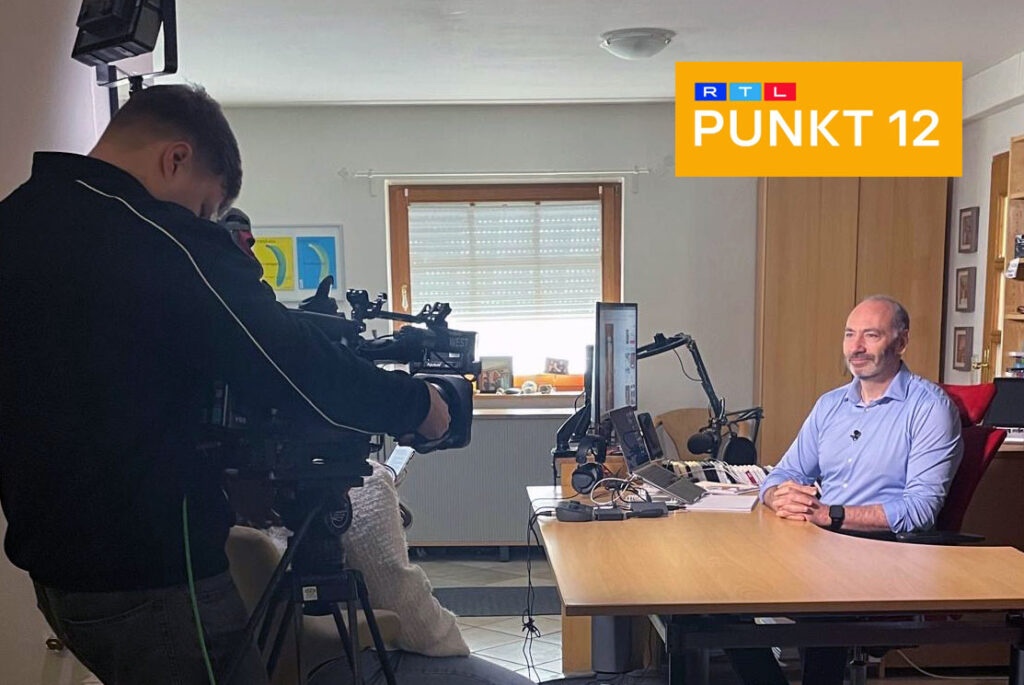
AI TikTok fruits – no trend has attracted as much attention in recent weeks as the AI-generated fruit soap operas that are currently racking up billions of views. Today, RTL Punkt12 (a major German midday news show) came to my office to talk about this phenomenon. What looks like absurd internet fun at first glance turns out to be a lesson about the future of media production.
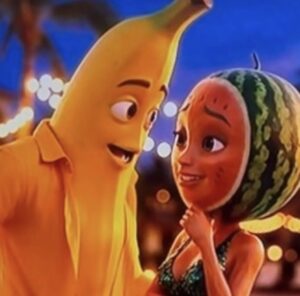
Why AI TikTok Fruits Are Dominating the Internet Right Now
Accounts like @ai.cinema021 publish daily short episodes featuring anthropomorphic fruits living through relationship dramas. Affairs, wedding sabotage, jealousy scenes. The format is reminiscent of reality TV shows like Love Island – except no human is involved anymore. Not in front of the camera, not behind it. The videos are entirely generated with AI tools: script, animation, voices, sound design. Within ten days, a single account gained over three million followers. Individual episodes reach view counts in the tens of millions.
What makes this remarkable: The creators behind these accounts are anonymous. Nobody knows who produces the content. The tools are freely available and so easy to use that literally anyone can create a viral video in under a minute. No camera, no editing software, no creative experience required.
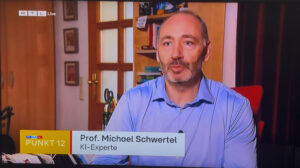
The Real Problem With AI TikTok Fruits Is Not the Technology
In my interview for Punkt12, I made a point that matters to me: AI is neither good nor bad. What matters is what people do with it. And what we are seeing right now is quite revealing.
Among the colorful fruit videos, you find polarizing and sometimes sexist content. And this type of content performs especially well on the platforms – not despite the fact that it provokes, but precisely because it does. It generates outrage, it triggers comments, it gets shared. The algorithm rewards emotion, not quality. Reach is built through friction. This is a textbook example of a fundamental problem: Platforms are designed to structurally favor problematic content as long as it generates engagement.
What makes this particularly concerning: The colorful, childlike look of the fruit videos masks content that is not suitable for children. Parents who hand their kids a phone often have no idea what hides behind the harmless surface. Homophobic and stereotypical storylines also appear – wrapped in cute animation that looks like a children’s video at first glance.

The Vanishing Quality Filter
This is the crucial point for me: A Hollywood production used to cost millions. That alone ensured that people thought carefully about the content beforehand. Purely out of economic self-interest. Every screenplay went through dozens of feedback loops before a single camera started rolling. Production costs served as a natural quality filter.
With automated AI productions, this natural barrier disappears completely. If a video doesn’t work, you delete it and produce the next one. Production costs are approaching zero. This dramatically lowers the threshold for problematic content, because the economic risk simply no longer exists.
The focus is on reach, not on content.
The consequence: Reach beats responsibility. And this is not a passing TikTok phenomenon. It is a preview of a media landscape where the production costs for video content will permanently approach zero.
What We Need Now
The answer is not less AI. The answer is more media literacy. We need to learn in schools, in companies, in families … to recognize AI-generated content, to put it in context, and to question it critically. It is not the technology that needs regulation. It is our ability to deal with it that needs education. And the responsibility should not be taken away from platforms, producers, and software companies.
This is especially true for children and young people who are growing up with this content and often have no way to distinguish between human-made and AI-generated material. Parents, schools and the platforms themselves all have a role to play here.
This is also one of the reasons why I developed the workshop “AI Vibe Filming” together with crossmedia journalist Markus Walsch: Once you have experienced firsthand how easy it is to produce AI content, you develop a very different sense for what is real and what is not.
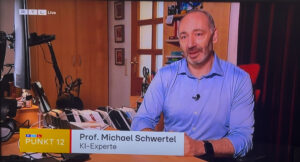
The RTL Punkt12 segment is [available here in the media library].
For media inquiries, please feel free to reach out – Contact.