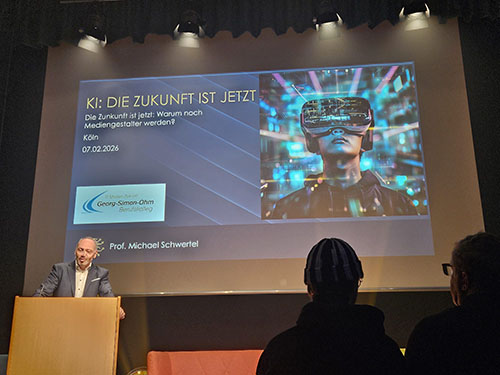
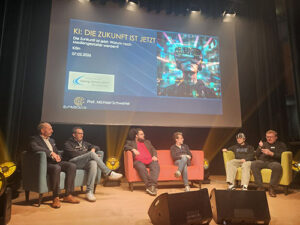
Recently, I had the opportunity to give a talk at the Simon Ohm Berufskolleg in Cologne, followed by a panel discussion. The title captured the core message very clearly: The future is now.
The central question was one that many students are currently asking themselves:
Why should you still train as a media designer when AI is changing everything?
Innovation is moving at a new speed
In my talk, I explained why innovation is accelerating so rapidly, especially through artificial intelligence. We are no longer talking about development cycles that take years. Today, new tools, systems, and workflows emerge in weeks.
This speed is fundamentally reshaping the profession of media design. What is considered modern today can feel outdated very quickly. That is exactly why waiting or doing nothing is no longer an option.
Why education matters more than ever
Despite all these changes, formal education still makes a lot of sense. In fact, it is becoming more important, not less. Media design education provides fundamentals: understanding of design, technology, workflows, and problem solving. These basics are essential if new technologies are to be used effectively.
I used a simple metaphor: It is like having a great car but driving with the handbrake on, stuck in first gear. Even if you later add a jet engine, the handbrake is still there. Technology alone does not make you faster. Understanding does.
Specialists instead of generic skills
The industry does not need people who only follow tools. It needs specialists who understand context, master multiple skills, and can translate the spirit of their time into design.
Nobody wants to see media design from 2020. What clients, audiences, and society expect is design that reflects today and anticipates what comes next.
AI agents and new ways of working
During the panel discussion, we talked about how teaching itself must become more flexible. AI should be part of education, but not as a shortcut. It should be used as a tool that builds on strong foundations.
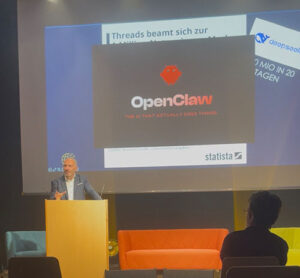
One interesting moment was the discussion around AI agents that can act independently and take over complex tasks. It was surprising to see that even in a very innovation-friendly environment, these systems were not yet widely known. This clearly shows how fast the landscape is changing and how strongly it will affect creative workflows.
Passion cannot be automated
A highlight of the event was a talk by a former apprentice who now works in event technology and pyrotechnics. The passion, responsibility, and problem-solving skills she described made one thing very clear:
Some professions cannot be replaced by technology or AI.
These jobs require experience, creativity, judgment, and commitment. You cannot simply replace that with an app or a software solution. Technology can support such work, but it cannot replace the human element behind it.
Conclusion
The fear of being replaced by AI is understandable, but often exaggerated. At the same time, standing still is not an option. The answer is not to learn less, but to learn more.
Education, continuous learning, and curiosity are the best preparation for the future.
That future is not far away. It is already here. And it needs people who are ready to actively shape it.